Saturday, 12 November 2011

Considerate Cycling 4


 I went for a bike ride around Bristol yesterday. I set off along Clifton Down, went across to Redland and then Stokes Croft, meandered through parts of the City Centre, and then made my way onto the Bristol and Bath Railway Path, coming home via Fishponds Road, Old Market and Park Row.

I didn't have any destination in mind, I was just following sign posts and whims to get a feel for how well the road system guided and protected cyclists in general. I tried hard to use cycling facilities as much as possible, and I didn't take a map or other information with me.

It's always a pleasure to be out on a bike in good weather, so I did enjoy the experience. But if you ask me whether Bristol is a cycle-friendly city I would have to say that it falls a wee bit short of being so. I don't want to make detailed observations of specific aspects, or offer comparisons with other places. Engineers and planners do all that for a living, and when I'm cycling I'm not that interested in the technical niceties. I'm reporting raw impressions here - the immediate feelings and experiences that would affect my willingness to evangelise for cycling as a great way to travel through and around the city.

What follows is a list of the most obvious problems that cropped up, or gradually accumulated over the couple of hours that I was out and about. Long as it is, it isn't exhaustive.

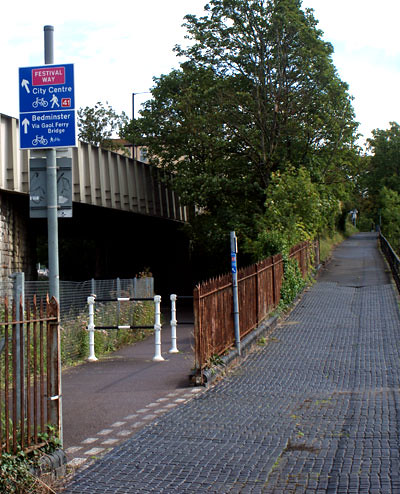
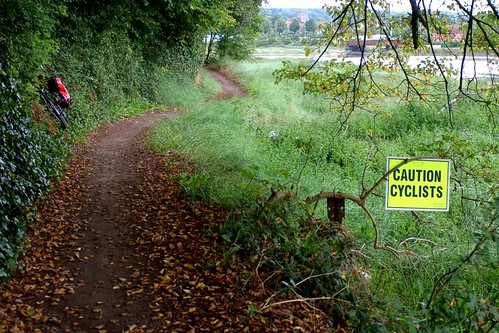
  1. Nothing persists. There are starts and beginnings in all sorts of places. Frequently during my journey a cycle lane, some cycle crossing lights, or a direction sign  attracted my attention. Most of them petered out pretty quickly, some of them almost immediately. Very little seemed to be joined up or continuous. The Bristol and Bath Railway Path is the obvious exception, but finding its start without maps, trials and errors is as good as impossible. Once on it, leaving Bristol is easy enough - just keep going. But getting back into Bristol is a magical mystery tour. Visitors from Bath will find precious little help in getting to the nice bits: there is certainly no consistent, obvious and reliable signage through the wilderness once the path has been left behind.
  2. Permission to cycle is confusing. I know from careful reading of specialised maps that some parts of Bristol permit cycling in shared areas that were originally built for pedestrians. Other very similar areas are designated as non-cycling. But in neither case, on the ground, is it obvious whether cycling is permitted or not. The result is that there is some cycling in almost every situation – legal or not. Those who no longer care cycle regardless of regulations, those who would like to be legal have no way of knowing (from what they see around them) whether cycling is allowed or not.
  3. Road crossings and junctions are confusing. Some combinations of lights, drop curbs, road surface marking and signs are bewildering (perhaps I'm just too old to cope?). The only way to avoid the confusion is to ignore them and keep a close eye on the traffic and the real hazards around you.
  4. Some cycle lanes are worse than useless. A cycle lane alongside parked cars is an invitation to take risks. I passed a couple of sections yesterday, and I know that there are others around the city. In my opinion you can have parked cars or a cycle lane, but not both. Being guided to pass within inches of parked cars on your left, while vehicle traffic passes inches to your right feels wrong. When I cycle past parked cars, I normally make sure that there is at least the width of an opened door between me and the cars. If this means taking a bigger chunk of the highway, I look behind me and then move further out from the hazard than a cycle lane normally provides for.
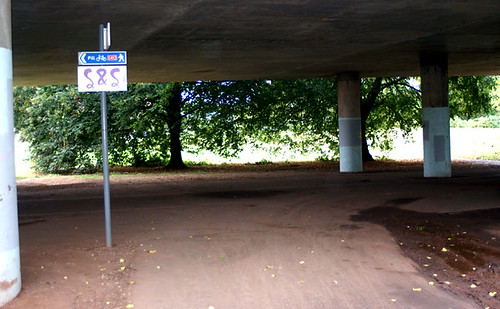
  5. Facilities are badly maintained. Paint on a road lasts a year or maybe two. There are plenty of lane markings and cycle symbols in Bristol that have been reduced to illegible flecks. Being early Autumn I noticed that many of the pretty and useful painted signs along the Bristol and Bath Railway Path are now obscured with mud and leaves. I had been looking so that I would know the name of my exit point. Direction signs for cyclist routes are easy to turn round, and some have been. It only takes one puzzling experience to lose confidence in all of them.
  6. Road names and confirmatory route signs are less common than I need them to be. Given that direction signs are few and far between, the help given by periodic confirmation of where I am and and where I am heading is reassuring. If you already know the way, of course, this doesn't apply. But after a mile or so on an unknown road I like to know that I am (or are not) still heading towards City Centre, or wherever else it was that the first sign had directed me. Major roads have all this covered very well for motor vehicle traffic. Cycling, with its shorter distances and slower speeds benefits from equivalent treatment.
  7. Major roundabouts are not designed with cycling in mind. One or two large and busy roundabouts had significant problems with lane choice for cyclists. On one occasion a lane marked with my intended destination on approach to the roundabout left me in the wrong place for safe exit, requiring a move across to a different lane while on the roundabout. Not a good feeling.
  8. Roads are littered with stationary vehicles. Whatever the rules seems to say, there are always vehicles parked on double yellow lines, junctions, pavements, at bus stops and on cycle lanes. Each one, I'm sure, is only there "for a minute or two" but every stretch of road seems to have at least one, obscuring a view of the road, narrowing the carriageway or stopping traffic. Vehicles waiting right up at the cycling advanced stop line at traffic lights are common.
However dismal all that sounds, I am still happy to keep cycling around the city. I enjoy it. The problems I found are ones I can manage and I will gradually learn to cope with or avoid the worst bits. But would I recommend, Boris Johnson style, that beginners or school children should simply ride with confidence, quick wits and the Highway Code for guidance? No, I wouldn't. Cunning, intuition, experience, good balance, strong legs, quick eyesight, research, patience and a friendly guide or mentor are all needed to get the full access to all the areas that you might want. Compared to the Dutch town I spent two weeks in during the 1970s, Bristol feels more like 1870, just like all the other lovely English cities I know. General enslavement to the motor car looks as hard to escape as it ever was.

Saturday, 1 October 2011

Best of Bristol Season: The Fleece September 27 2011


In June this year, I moved to Bristol.  For ten years or so I have been paying attention to the local music scene in Leeds. I have enjoyed seeing and hearing a wide range of people with names that include Bilge Pump, I Like Trains, David Thomas Broughton, That Fucking Tank, ¡Forward, Russia!, Cowtown, The Scaramanga Six, Pulled Apart By Horses, Sky Larkin, Jon Gomm, Bear Diver, Hawk Eyes, Wild Beasts, Trumpets of Death, Jasmine Kennedy and lots more. Dozens more. It has been a rich decade in the city.

So this week, just about settled into our Bristol flat, I went down to The Fleece for one of the last of their "Best Of Bristol" nights for the season. Four bands, £6 on the door. Perfect. Experience tells me there will be one band that I really like.

And so it turns out to be.

COASTS

When COASTS came on  there were about 15 of us in the audience. Not bad for 8.15 on a Tuesday night. They  were a very tidy band. They had nice gear, nice instruments, and they played and sang really well. The sound engineer gave them  a lovely full mix with everything working as it should. I was impressed in a sniffy sort of way at seeing a genuine timp on stage. Blimey. Every song they did was well-rehearsed and  sounded convincing. There were three part harmonies, rising Roland chords, the excitement of extra cowbell, and the vocalist hammering drums from time to time.

Even so, nothing shouted out to me from under the expert sheen. I wasn’t surprised, later on, to find out that they are linked with a company called Intruder, who are interested in selling stylish clothing and who have a neat-looking roster. For most of their set pre-recorded American voices did that standard alienation thing so that the band could neither announce who they were nor what their songs were called. It was a bit wearing to be honest. It was as if they were playing to some other, imaginary audience, out there. 


WINSTON EGBERT 

COASTS' gear took a while to carry off stage, but mixed double WINSTON EGBERT who followed were less encumbered.  They came on, played a blinder, and were gone quicker than a bag of crispynut cockroaches. Serena Cherry (drums and vocals) and Liam Phelan (guitar and vocals) gave every impression that they make their feisty punk thrash out of true love for the noise and the mad delight of showing it off. It was fast, heavy, juddering, scary and hilarious all at the same time. Like a hippo on a skateboard. Or a squirrel with the controls to a JCB. Dry sarcasm about Stokes Croft, or a lament for lost metal heroes ... all grist to their fast revolving mill. This was my reward for coming. I loved it. In answer to that age old American Moral Dilemma "When is it OK to kill you mother?"  they offered the answer "when she forces you to be a vegetarian". They made it sound fun and each screamed thier different screams.  When they were loud they were very very loud and when they were quiet it went silent.


NEOTROPICS

Someone told me that NEOTROPICS were verging on Euro Electropop, and he wasn't far off. Electropop for sure. Bryn, Tom and Rhys play guitar bass and drums while a backing synth track keeps the harmonising swirls going in standard patterns. Dancing might have been an option, but the 20 or 30 people in the audience don't look as if they are going to cooperate. It's all a bit glum and I start to get irritated by the one chord per bar backings and the nearly well-known tune that I can hear in the background, without being able to remember where I have heard it before.

The best tunes could be something really exciting and the last number lifts the set with character and a bit of dynamic tension. But overall the performances have been Lego bricks lined up to create monotony without transcendence.


ComScore


ATTACK HORSE

The headline for the night, whose audience of 50 or so have been coming in gradually, are a quirky band of older music fans with musical ambition and lots of great ideas. Their performance is disruptive and perverse, with occasional bursts of melodic or rhythmic fascination. I can hear some Talking Heads and some Beefheart and some Pavement, and all sorts of other bits of disdainful intelligentsia. The 1980s are a strong suit in their game. B52s get a look in at an early stage.

It's disappointing that their audience don't feel confident about making a bit of a night of it. There is a sense of friendly support and general approval in the room, but very little genuine engagement or excitement. A mordant slacker approach can work as incitement, but perversely the rhythm section hasn't really got the drive or the punch to make that work. The attack tends to come in vocal bursts and extemporisation that stall and distort the flow without cracking the Mark E Smith whip at any point. Being Tuesday I sense this might not be the best gig they've done this year. So I hope to see them again before too long.

Find more Attack Horse songs at Myspace Music


So I got to see four bands and really liked one of them. All the others were well worth the money and time and a different writer would have picked a different band to be enthusiastic about.

But the one thing I'm still puzzling about was the apparent lack of contact between the bands. As far as I could tell only ATTACK HORSE stood through other bands' sets and the supporters who had come for COASTS seemed to leave as soon as their band's set was done. Give that the Fleece is a big room with a pretty good stage, big sound and a lot of publicity I would have expected a total crowd of at least a 100, with most staying all the way through and most members of all bands being in the room for a lot of the time to support the other bands on the bill.

Maybe this was an exception – a last exhausted gasp towards the end of a good summer, with the big Autumn gigs yet to come. I'll be finding out gradually as winter rolls on.

Suggestions for exciting Bristol music happily accepted. As you will have already noticed, I've got a lot to learn.

Wednesday, 21 September 2011

Considerate Cycling 3

I have been provoked into this. A Bristolian cyclist (@sprinstar) tweeted this morning to ask if Bristol should be rated in the Copenhagenizelist of top cycling cities.  A simple answer is that Bristol is too small a city to be considered for that list anyway. But the spirit of what @sprinstar wrote is what matters. It was strong provocation.
 
Adding the mournful typogram :( - he concluded "sometimes I think Bristol is going backwards" and all my Bristol cycling anxiety bubbled up. "Why", I thought "does cycling around Bristol bring out such ambivalent feelings in me?". I have only just got here and hardly know my way round at all. But after only 3 months, for every positive feeling about how good it is for cycling, there's a really negative experience that puts me right back into feelings of sullen frustration and annoyance.
 
So, all the positives accepted and noted, let me set out the experiences that stop Bristol being the great cycling city that it is in my dreams.
 
1) Signage is maddeningly inconsistent and unreliable. This is a blog in itself. Several different bodies are involved here and so there is no obvious target to blame. Looking at every kind of sign, from road and path surface marking, through finger signs, street name signs, direction indicators, confirmation way markers, route number markings, to official mandatory, advisory, permissive and advanced warning indicators: all suffer from degrees of neglect, absence, poor visibility, ambiguity, poor placement and redundancy. Basically, a mess. Some is beautifully clear and prominent – encouraging enthusiasm and adventurous exploration.


And then, gaps and vagueness appear at crucial junctions and the adventurer gets lost. Some is mystifying, some has been clearly vandalised, some is just perverse. Some is just not there.


Someone has removed the sign that explains whatever lies to the right of this sign. Only those who already know where they are going are happy. (some more signs can be seen on my flickr site here and here)

2) Official maps are encouraging but not always very helpful. Bristol City Council has a set of cheerful and detailed leaflets  showing a range of cycle routes and amenities across and around the city. They look appealing and they are sent out, or can be downloaded, free of charge. In practice they either lack required detail or else pack things so tightly together that using them on the road demands too much intuition and guesswork (maybe I'm just a poor map reader?). With poor signage, ambiguous or difficult-to-read maps are even more frustrating.

3) Physical provision is fragmented. Nothing about cycling in Bristol is free-flowing. The longest uninterrupted sections of cycling are on shared pedestrian/cycle paths – very definitely a second-best option in my book. Shared paths are only trouble-free when no one else is using them. For pedestrians they can make relaxation impossible. For a cyclist they reduce the normal rhythm of a cycle journey to a forced and frequently interrupted meander. Short sections of contra flow cycle lane in one way streets (eg Nelson Street) and fragments of cycle lane alongside loading/parking places (Gloucester Road, I think) are just plain dangerous. Some unexpected bits of cycle lane within multi-lane roads, ahead of roundabouts, near the city centre demand almost suicidal courage to use at all.

4) Cycling culture in Bristol is, broadly speaking, anarchic. I don't see any overt antagonism from motorists or pedestrians, but as a pedestrian (I walk a lot) I am regularly disturbed and sometimes shocked by cyclists in unexpected (non-legal) places. Perhaps the poor signage is to blame. But even where NO CYCLING is clearly painted in large letters across a footpath on the Downs, plenty of cyclists pay no attention. Footpaths have become a de facto set of optional cycle paths for a lot of Bristol cyclists. Many open areas in the centre of Bristol are marked on the maps as "shared" or "pedestrian". Presumably most people have never seen the maps, because they are all treated as "shared" by very many cyclists. One of my early shocks in Bristol was seeing this scary looking video: 


A cycling campaigner is demonstrating the "Brunel Mile" in which a footpath across Queen Square is used (see from 0.34) instead of the "proper" cycle route on the south side of the square that is marked on the ground by rather elegant paving slabs.


5) Everything defers to the motor car. Obviously, this is not Bristol City Council Official Policy but it might just as well be. As long as so much of all our lives is taken up by ownership and use of the car, everything else that wants to move is going to have to wait. Parked cars line most of Bristol's smaller roads, and even where parking is not allowed, parked or waiting vehicles create hazards for cyclists at regular intervals. The narrow cycle lanes that have been painted (almost never constructed) alongside roads are normally blocked at intervals along the route by a stationary car or other vehicle. Cracks and potholes are numerous.

What we need to do, I think, is think before demanding the impossible or the contentious, and make more efforts to maintain and mend the things we already have. It's good. It could and should be better. I have a feeling that if cyclists keep on asking for more, the negative aspects of what we already have will put a real drag on progress. The high level of consideration afforded cyclists by other road users (especially the hard-pressed pedestrians) in Bristol will evaporate if we can't be more confident and considerate as cyclists.

Saturday, 10 September 2011

A Letter From A Member Of Parliament

After Thursday's division on the Third Reading of the Health And Social Care Bill in the House of Commons this week I got a copy of the generic letter that Stephen Williams MP sent to all those who had contacted him about the Bill. He wrote:
Dear Sam Saunders,

Health and Social Care Bill

Thank you for your recent correspondence regarding the Health and Social Care Bill.  A great many Bristol West residents have contacted me about this Bill and my intention is that this reply will cover all of the main points that have been raised.

Most of the Bills discussed by Parliament are non-contentious and arouse limited debate.  It comes as no surprise that a Bill reforming the NHS and social care has received a great deal of attention, both within Parliament and from external commentators.  This particular Bill has now been under discussion for more than 6 months.  Quite apart from the many representations received by MPs from constituents and lobby groups, the Bill has been the subject of major debate between the two governing parties in the Coalition Government.  The Liberal Democrat spring Party Conference in March 2011 debated this issue and called for changes to the original Bill.  Nick Clegg and Andrew Lansley agreed to “pause” the detailed Parliamentary scrutiny of the Bill in order to allow for more external consultation.  The Bill considered by MPs over the last two days (6th-7th September) is much changed from the original version as a direct result of this further discussion.

On Wednesday the Bill received its approval by the majority of MPs, including myself.  It now passes to the House of Lords for further debate and possible amendment.   Whatever your opinion of the final outcome I hope you will agree that this long and detailed consideration by the Coalition government is a great improvement on the many examples of contentious legislation being rail-roaded through by a single party, which was my experience during the time of the previous government.  I will now turn to the detailed points raised in the letters and emails that I have received.

Firstly, there has been the spectre of “privatisation” or “break up” of the NHS into some model resembling health care in the USA or many EU states. I am clear that there was never any intention that this was the purpose (or an unintended consequence) of the Bill.  There was never a chance that I and my Lib Dem colleagues would have allowed that to happen; I can emphatically assert that there will be no “privatisation” of the NHS and no special concessions (i.e. “cherry picking” or favourable tariffs) to private sector providers of health care.  The NHS will remain free at the point of need and treatments will be paid for by our taxes.

It is important to note that this does not mean that there is no role for non state owned providers of health care.  Ever since its inception in 1948, the NHS has commissioned care from private doctors and companies.  The vast majority of family doctors in Bristol West are essentially private professional practices which derive most of their income from the NHS.  There always has and there will continue to be a mixture of providers of health care.  The important point for each patient is that the treatment is paid for by the NHS, no matter from whom it has been commissioned.

Another concern that many constituents have highlighted has been the role of the Secretary of State for Health.  The original 1947 Act that established the NHS made the Minister for Health responsible for the provision of a comprehensive system of health care.  Reforms of the NHS by successive governments have amended that duty, essentially reflecting that fact that government is usually an enabler rather than a direct provider or commissioner of services.  Indeed, the current situation is that Secretary of State delegates the commissioning of health care to a network of Primary Care Trusts (NHS Bristol in our case), each with their own Board and Chief Executive.  Those trusts commission health care from GPs, Hospital Trusts (mainly, but not all, state owned) and a variety of other businesses, including the private sector.  Some doubt was expressed as to whether this duty of the Secretary of State was being weakened under the Bill.  I have read carefully the Department of Health’s legal advice and received direct assurance yesterday from Paul Burstow MP (Lib Dem Minister of State for Health and Social Care) that the Health Secretary will retain ultimate responsibility for the provision of health care

Indeed, the duties of the Health Secretary have been widened by the Bill.  Firstly, the Health Secretary must ensure that the Government is actively attempting to reduce health inequality.  As Chair of Parliament’s cross party committee on Smoking and Public Health I very much welcome this new duty.  Public health and the shocking disparities in life expectancies between different social groups has not been given the attention it deserves in the past.   Secondly, the Health Secretary will also have a new legal responsibility to make sure that the NHS is an active participant in medical research.  Bristol is of course a major national centre of excellence for several areas of medical research.

Aside from the corporate status of the NHS and the duties of the Health Secretary, many people have cited “competition” and “EU regulations” as a concern.  The Bill does not make any substantive change to the levels of competition for health care already in existence.  The NHS has a massive procurement budget and a large number of suppliers.  As such it has always had to abide by competition rules (both UK and EU wide depending on the size and nature of the contract) when it contracts out for services.  The Health and Social Care Bill will not alter this long standing situation.  I would also refute the assertion that competition is an alien or evil concept in health care.  Competition is about maximising patient choice and also value for money for the taxpayer. 

However, I do understand and agree with concerns that businesses should not make unfair levels of profit from health care. The Coalition government intends that this Bill will place important limitations on the applicability of competition law so that those charities or private firms who do bid to provide treatments should not be allowed to “cherry-pick” or undercut on matters of price. Where competition is present it will be in areas such as quality and alternative treatments, not on price for specific treatments as these come under a set NHS tariff.  Furthermore, unlike the previous government, the Coalition is determined that it will not simply promise payment to such organisations regardless of whether those organisations have seen NHS patients. The last government encouraged the setting up on Independent Sector Treatment Providers, specifically to compete with NHS Trust Hospitals.  There is one in Bristol, at Emersons Green.

The Government believes that any disputes which occur between organisations which are involved in seeing and treating NHS patients, regardless of whether these bodies are public or private, should be dealt with by a regulator which is specifically devoted to health matters (know as Monitor), rather than the Office of Fair Trading (OFT). This is an important enhancement under the Bill, as the remit of the OFT is arguably too broad to deal with such disputes and a specific health sector regulator is welcome.

Throughout the consultation on this Bill, the Liberal Democrats have sought to emphasise the importance of properly integrating local health services and ensuring their sustainability, and enhancing local as well as Parliamentary accountability.  As well as confirming existing and introducing new duties for the Health Secretary, the Bill also gives much more scope for decision making and scrutiny in Bristol.  A new Health and Well Being Board will be set up in Bristol and the City Council will also have new duties in public health.  I believe that we will be able to build an NHS that has a strong set of legal duties on the national government, but where local health care professionals and politicians will be able to design and commission health care services that address local needs.

The Liberal Democrats have made valuable changes to the Health and Social Care Bill which I believe will not only secure the future of a comprehensive system of health care but also lead to improved levels of service.  The very nature of health care means that we cannot have a template of provision that can never be subject to reform or innovation.  Advances in medical research and demographic change mean that we must make sure that our system of health care matches contemporary needs and circumstances.

Finally, a personal note.  Rest assured that I greatly value the NHS and I fully understand that many people in Bristol regard it as our greatest national institution. I have a direct personal interest in the NHS as a long term patient at one of Bristol’s main hospitals.  The issues discussed in this note are as important to me as they are to you and I have given them a great deal of thought over many months. No piece of legislation can ever satisfy everyone and no doubt there is a scope for further improvement and clarification as the House of Lords now considers the Bill.  I thank you for your interest in the Bill and hope that this reply has reassured you.
  
Yours sincerely
Stephen Williams MP


In summary he says:
  1. We have made a lot of changes to the first attempt to change the NHS.
  2. There will now be no privatisation and no easy profits for suppliers. Patients won't be asked to pay for their treatment.
  3. The NHS has always bought supplies and services from private companies.
  4. GPs in Bristol West are mostly private practitioners who work for the NHS.
  5. In a largely devolved system the Secretary of State for Health will retain overall responsibility for the provision of health care.
  6. The responsibility will include a duty to reduce inequality in health care and to require the NHS to support research.
  7. There are no important changes to the role of competition in health care provision.
  8. Profiteering and market abuse in the competitive aspects of health provision will not be allowed.
  9. A Monitor for the NHS will ensure that such profiteering will not go unchecked.
  10. Local politics will still have a role to play in NHS provision.
  11. The Liberal Democrats have helped by making changes to the first proposals.
  12. Stephen Williams MP has been an NHS patient himself, with long term treatment in a Bristol hospital.

I think this is all very optimistic and I sincerely hope he is right is the implicit suggestion that the Tories have now abandoned the idea of dismantling public health provision. The Tory Election promise to do no centrally managed  reform has clearly been abandoned and it is good to see that despite claims of financial crisis large sums of money can be found to provide a job creation scheme for health managers to open new offices and to move people from one desk to another.

The outcomes of chaotic events can never be known - but as long as nurses and doctors and other health professionals have the will to do their best for patients (whatever nonsense is poured on them from above) we might avoid the outright scandal of US health provision and the gradual decay of the co-operative ethic.

Fingers crossed eh? I'm also with Mr Williams in hoping that the House of Lords (so recently packed with Cameron's Chums) can remedy some of the nonsense that is still in the Bill. A Bill, let us not forget, that no one voted for in the last election, for which there is no immediate need and which will soak up large sums of money that could have gone to direct use in health care itself.  It is and always was, a vanity bill intended to further the libertarian cause of Big Business and the self interest of rich people. The Liberal Democrats (if what Stephen Williams says here turns out to be true) will have saved the Tories from a humiliating defeat and kept the hopes of the private health lobbyists alive.

Monday, 29 August 2011

A Letter To A Member Of Parliament

This morning, having skimmed my Twitter messages, I came upon an article in the British Medical Journal. All of a sudden it seemed urgent to say something to someone about what I thought. So I wrote to Mr Stephen Williams, MP for Bristol West - the constituency in which I now live and where I am registered to vote. This is what I wrote:

Dear Mr Williams,

Of all the damage being done by the Tories at the moment there is nothing as fundamental and nothing as contrary to British post-war consensus as the Bill that is about to damage the foundations of the health service.

In my opinion your article on the subject (http://stephenwilliams.org.uk/en/page/nhs-reforms) is timid and lacks the sense of urgency or vision that I would have hoped for. It seems to accept that you are going to vote in favour of something that most of your constituents would be against. The Bill as it stands is driven by a mixture of libertarian (not liberal) idealism, the financial self interest of pharmaceutical and insurance businesses, and the individualistic ambition of some health professionals. Once it is enacted, the remaining checks and balances that you seem to want to trust will sooner or later be washed away by the power of "market" forces. The National Health Service will not be able to remain a genuine public service once the new dispensation has started running. Cameron wants "NHS" to be no more than a brand and is keen to remove the difficult questions of resource allocation away from the realm of public debate and democratic decision.

The National Health Service was started as, and in many hearts remains, a deeply held moral principle and practice. I was born a year after the NHS began, and I look forward to my grandchildren being able to enjoy it as I have done and as my children have done.

I am asking you to re-read the BMJ article by Pollock and Price and to be visionary in how you vote in Parliament. The full text is here: http://tinyurl.com/3nddg8n


With best wishes

Sam Saunders
We are, I believe, not "customers" of the NHS, we are partners and participants. We need to cherish, support and understand it. The Tories want it to be the McDonalds of the health industry - just another glass-fronted outlet where we can browse for the least unattractive offering in a high street full of more expensive options.

Tuesday, 16 August 2011

Considerate Cycling 2

I have been enjoying the roads and paths of Bristol quite a lot since I last wrote. Yesterday I went from Clifton to Temple Meads station via The Suspension Bridge, along various tracks and cycle lanes and on a bit of the National Cycle Network's Route 41. Fabulous.

Here are some ideas on Considerate Cycling, as promised in the last piece.

Be heard. Buy, fit and use a bell. I got a lovely cheap small one from Fred Baker Cycles. One flick with the thumb and it sends out a gentle, sustained and penetrating piiiiiiiiiiing that avoids the bad-tempered spring-loaded rasp of ancient times. I find mine very helpful on the riverside where families are wandering happily along the shared path. They appreciate the early warning-time to gather themselves and their little ones before the hazard arrives. A ping before an unsighted bend is very handy too. A bell might disturb the peace, but last minute shocks and confusion are much worse.

Be visible. In the days when I drove a car regularly the very late sighting of a dark-clad cyclist with no lights always scared and upset me. When I am driving with lights on, behind a windscreen, with other lights coming towards me, movement in the shadows is very hard to see. I don't think I'm the only person with this defect. On a bike dusk feels OK. I can see everything from my bike, but for motorists it's different. Lights and reflective clothing are not just considerate, they are vital. In broad daylight, something bright to wear and a good upright posture, well away from the gutter all help other road users to notice you early and give you (and themselves) a chance.

Be brave. Look behind you, signal boldly, sit right up and look others in the eye. Make a show of moving safely into the proper lane or the middle of the road if that is where you should be. Stay well away from narrow gaps, gutters and pot holes and leave the sneaky blind side of any vehicle bigger than you are well alone.

Be predictable. It should go without saying, but uncertainty adds to anxiety and anxiety leads to poor judgement. You can reduce the highway distress of others by doing What You Should Be Doing. The 30% of road users who think of themselves as "Below average" in confidence and skill are definitely helped if the unexpected cyclist is on the left, moving in the right direction in a one-way street and visibly paying attention to others.

Be receptive. Dark goggles at night? Audio earphones at any time? Good clear vision and acute hearing are a real blessing. If you have them you can be more attentive to and respectful of others and reduce their risk of having to call for your ambulance when they hit you. Listening to speech or music absorbs attention that could be on hazards, and reduces your ability to hear. Noticing a gear change behind you could warn you of the unexpected left turn across the bows that so frequently afflicts cyclists.

Be attentive. Cycling is such a pleasure (even in the city) that daydreams and good ideas flood in as the blood pumps through your body. If you deliberately pay attention to the road around you, more immediate difficulties can be reduced by early changes in speed or road position. You spot the early-morning parent who has just stopped and who is about to open an offside car door to let the child out for school. You see the broken inspection cover soon enough to warn others before you pull out and go round it safely.

Be patient. This is the hardest and the most important thing. On a shared path is 20mph really being kind to others? That could be 10 times faster than they are but it will change your journey to work time by only a few minutes (if you get there). Is it going to improve your life if you get over the traffic light three minutes earlier than everybody else?

Be polite. When someone has upset you by acting dangerously or illegally, try to let it go. Can you be sure they did it just to irritate or injure you personally? Have you never done anything silly or careless?

Be thoughtful. A bus might have 50 people on board. They would all like to get home. A queue of traffic on a hill or a narrow road might include a midwife on a mission. It only takes a moment's thought to see a place to stop or pull well over to let them through. I know it's your road too, but that's what gives you the right to be generous with it.

Be yourself. When other cyclists jump a light, mount the pavement or hurtle round a blind corner there's an invisible social bond that pulls you with them. This is great when you're on the Tour de France. But life back here on earth feels great when you've mastered the art of turning it off, making your own decisions to be considerate and letting them go.

Use the lifesaver often, and always use it before setting off. The lifesaver is a full head turn that looks steadily at all the road behind you. If it makes you wobble, practice on waste ground or a quiet road. It helps you to see but it also provides that visible clue to others that you are thinking about them and planning to do something that could affect them.

Thursday, 11 August 2011

Considerate Cycling

I have just read a Guardian blog about conflict in Toronto between different road-using factions. It's pretty alarming. Read it here The author wrote something that really made me sit up and squeak. The passage was:

I would argue that cyclists who behave carelessly are either consciously or unconsciously responding to an equally careless attitude to cycling at a municipal level.
Now that's a point of view that could be  supported with a variety of evidence and logic. It's not wrong in itself.  But it does fly right across the experiences I have had in the last two months in the city I have just moved to. Bristol is a lovely place. It has cycle lanes all over the city with cycle paths shooting out of town in all directions. Temple Meads Railway Station has a huge cycle parking area on the main platform and everywhere I look there are good Sheffield cycle racks. I have already seen several  very good bike shops and have used one and got excellent service (Fred Baker Cycles in Cheltenham Road) . There are advance stop lines and generous lead in paths at a lot of junctions. And so on.

However, the level of consideration for other road and footpath users and the degree of adherence to traffic regulations by Bristol cyclists are every bit as bad as the provision for their bikes is good.  Things aren't nightmarishly bad, but the provision is nowhere near perfect either.

In defence of my conclusion I have spent several sessions watching from a window at a major junction on Cheltenham Road, and have done quite lot of walking around Clifton and the City Centre. Routine events include:

  • Cycling on footpaths, often at speed and without making allowances for pedestrians in close proximity or for the possibility of people emerging from shops or houses.
  • Sudden changes of direction - road to path to road, for example
  • Cutting corners at junctions by mounting the pavement
  • Cycling across zebra crossings alongside and in between pedestrians.
  • Ignoring red lights in busy traffic.
  • Weaving in and out of pedestrians in shopping areas.
  • Cyclists going down steep hill in busy streets at speeds that would make stopping impossible.
  • Cyclists using shared paths at reckless speeds and ignoring the keep left rule of the road with other cyclists.
  • Cyclists manoeuvring without first checking behind.

In one case an older woman at a bus stop was brushed by a middle aged woman on a bicycle who still didn't dismount, but wobbled off to threaten others.

This sort of behaviour seems to go way beyond anomic shrugging at the ineptitude of the civic authorities. It isn't matched by Bristol's car, bus lorry, or van drivers either - I have seen lots of courtesy and consideration from these. Stopping for zebra crossings, for example, is almost embarrassing in its religious observance: I saw two lines of traffic in Gloucester Road waiting patiently for one young man to finish his mobile phone conversation before he crossed.

The lack of consideration for others seems to me to be simply a habit acquired from imitating others - it's like the Bristol accent or this year's haircuts. It's just taken-for-granted and anyone who spoke out or stopped anyone would simply cause annoyance or amazement. The cyclist concerned would never have thought that their own personal journey through the city touched anyone but themselves. They are doing what they believe is safe (for themselves) and what is convenient and pleasurable (for themselves).

Pedestrians who are startled by a sudden and unexpected rush of wind, parents with push chairs trying to cross a road safely, motorists waiting patiently for an approaching bike who suddenly turns left without indicating, infirm or partially sighted people coming out of a shop into bright light and sudden confrontation, daydreamers who have chosen the safety of a pedestrian controlled crossing - only to be awakened by a bike doing 20mph in their path: all these people deserve a little consideration I think. I'm not going to start a campaign or harass anyone about it. But I will try to cycle as I preach, knowing that roads and traffic are very complex these days and that mistakes are not difficult to make.