Showing posts with label consideratecycling Bristol. Show all posts

Wednesday, 21 September 2011

Considerate Cycling 3

I have been provoked into this. A Bristolian cyclist (@sprinstar) tweeted this morning to ask if Bristol should be rated in the Copenhagenizelist of top cycling cities.  A simple answer is that Bristol is too small a city to be considered for that list anyway. But the spirit of what @sprinstar wrote is what matters. It was strong provocation.
 
Adding the mournful typogram :( - he concluded "sometimes I think Bristol is going backwards" and all my Bristol cycling anxiety bubbled up. "Why", I thought "does cycling around Bristol bring out such ambivalent feelings in me?". I have only just got here and hardly know my way round at all. But after only 3 months, for every positive feeling about how good it is for cycling, there's a really negative experience that puts me right back into feelings of sullen frustration and annoyance.
 
So, all the positives accepted and noted, let me set out the experiences that stop Bristol being the great cycling city that it is in my dreams.
 
1) Signage is maddeningly inconsistent and unreliable. This is a blog in itself. Several different bodies are involved here and so there is no obvious target to blame. Looking at every kind of sign, from road and path surface marking, through finger signs, street name signs, direction indicators, confirmation way markers, route number markings, to official mandatory, advisory, permissive and advanced warning indicators: all suffer from degrees of neglect, absence, poor visibility, ambiguity, poor placement and redundancy. Basically, a mess. Some is beautifully clear and prominent – encouraging enthusiasm and adventurous exploration.
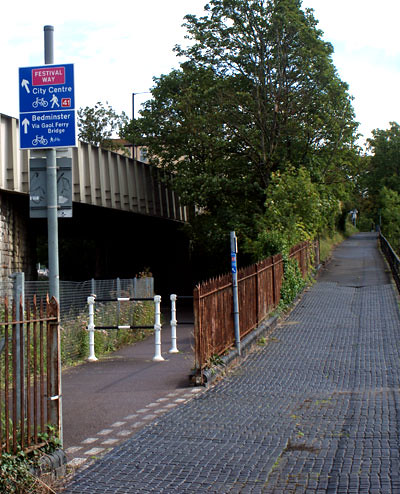

And then, gaps and vagueness appear at crucial junctions and the adventurer gets lost. Some is mystifying, some has been clearly vandalised, some is just perverse. Some is just not there.
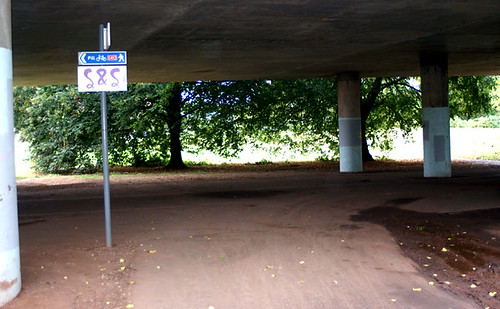


Someone has removed the sign that explains whatever lies to the right of this sign. Only those who already know where they are going are happy. (some more signs can be seen on my flickr site here and here)

2) Official maps are encouraging but not always very helpful. Bristol City Council has a set of cheerful and detailed leaflets  showing a range of cycle routes and amenities across and around the city. They look appealing and they are sent out, or can be downloaded, free of charge. In practice they either lack required detail or else pack things so tightly together that using them on the road demands too much intuition and guesswork (maybe I'm just a poor map reader?). With poor signage, ambiguous or difficult-to-read maps are even more frustrating.

3) Physical provision is fragmented. Nothing about cycling in Bristol is free-flowing. The longest uninterrupted sections of cycling are on shared pedestrian/cycle paths – very definitely a second-best option in my book. Shared paths are only trouble-free when no one else is using them. For pedestrians they can make relaxation impossible. For a cyclist they reduce the normal rhythm of a cycle journey to a forced and frequently interrupted meander. Short sections of contra flow cycle lane in one way streets (eg Nelson Street) and fragments of cycle lane alongside loading/parking places (Gloucester Road, I think) are just plain dangerous. Some unexpected bits of cycle lane within multi-lane roads, ahead of roundabouts, near the city centre demand almost suicidal courage to use at all.

4) Cycling culture in Bristol is, broadly speaking, anarchic. I don't see any overt antagonism from motorists or pedestrians, but as a pedestrian (I walk a lot) I am regularly disturbed and sometimes shocked by cyclists in unexpected (non-legal) places. Perhaps the poor signage is to blame. But even where NO CYCLING is clearly painted in large letters across a footpath on the Downs, plenty of cyclists pay no attention. Footpaths have become a de facto set of optional cycle paths for a lot of Bristol cyclists. Many open areas in the centre of Bristol are marked on the maps as "shared" or "pedestrian". Presumably most people have never seen the maps, because they are all treated as "shared" by very many cyclists. One of my early shocks in Bristol was seeing this scary looking video: 


A cycling campaigner is demonstrating the "Brunel Mile" in which a footpath across Queen Square is used (see from 0.34) instead of the "proper" cycle route on the south side of the square that is marked on the ground by rather elegant paving slabs.
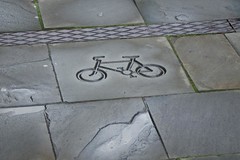

5) Everything defers to the motor car. Obviously, this is not Bristol City Council Official Policy but it might just as well be. As long as so much of all our lives is taken up by ownership and use of the car, everything else that wants to move is going to have to wait. Parked cars line most of Bristol's smaller roads, and even where parking is not allowed, parked or waiting vehicles create hazards for cyclists at regular intervals. The narrow cycle lanes that have been painted (almost never constructed) alongside roads are normally blocked at intervals along the route by a stationary car or other vehicle. Cracks and potholes are numerous.

What we need to do, I think, is think before demanding the impossible or the contentious, and make more efforts to maintain and mend the things we already have. It's good. It could and should be better. I have a feeling that if cyclists keep on asking for more, the negative aspects of what we already have will put a real drag on progress. The high level of consideration afforded cyclists by other road users (especially the hard-pressed pedestrians) in Bristol will evaporate if we can't be more confident and considerate as cyclists.

Tuesday, 16 August 2011

Considerate Cycling 2

I have been enjoying the roads and paths of Bristol quite a lot since I last wrote. Yesterday I went from Clifton to Temple Meads station via The Suspension Bridge, along various tracks and cycle lanes and on a bit of the National Cycle Network's Route 41. Fabulous.

Here are some ideas on Considerate Cycling, as promised in the last piece.

Be heard. Buy, fit and use a bell. I got a lovely cheap small one from Fred Baker Cycles. One flick with the thumb and it sends out a gentle, sustained and penetrating piiiiiiiiiiing that avoids the bad-tempered spring-loaded rasp of ancient times. I find mine very helpful on the riverside where families are wandering happily along the shared path. They appreciate the early warning-time to gather themselves and their little ones before the hazard arrives. A ping before an unsighted bend is very handy too. A bell might disturb the peace, but last minute shocks and confusion are much worse.

Be visible. In the days when I drove a car regularly the very late sighting of a dark-clad cyclist with no lights always scared and upset me. When I am driving with lights on, behind a windscreen, with other lights coming towards me, movement in the shadows is very hard to see. I don't think I'm the only person with this defect. On a bike dusk feels OK. I can see everything from my bike, but for motorists it's different. Lights and reflective clothing are not just considerate, they are vital. In broad daylight, something bright to wear and a good upright posture, well away from the gutter all help other road users to notice you early and give you (and themselves) a chance.

Be brave. Look behind you, signal boldly, sit right up and look others in the eye. Make a show of moving safely into the proper lane or the middle of the road if that is where you should be. Stay well away from narrow gaps, gutters and pot holes and leave the sneaky blind side of any vehicle bigger than you are well alone.

Be predictable. It should go without saying, but uncertainty adds to anxiety and anxiety leads to poor judgement. You can reduce the highway distress of others by doing What You Should Be Doing. The 30% of road users who think of themselves as "Below average" in confidence and skill are definitely helped if the unexpected cyclist is on the left, moving in the right direction in a one-way street and visibly paying attention to others.

Be receptive. Dark goggles at night? Audio earphones at any time? Good clear vision and acute hearing are a real blessing. If you have them you can be more attentive to and respectful of others and reduce their risk of having to call for your ambulance when they hit you. Listening to speech or music absorbs attention that could be on hazards, and reduces your ability to hear. Noticing a gear change behind you could warn you of the unexpected left turn across the bows that so frequently afflicts cyclists.

Be attentive. Cycling is such a pleasure (even in the city) that daydreams and good ideas flood in as the blood pumps through your body. If you deliberately pay attention to the road around you, more immediate difficulties can be reduced by early changes in speed or road position. You spot the early-morning parent who has just stopped and who is about to open an offside car door to let the child out for school. You see the broken inspection cover soon enough to warn others before you pull out and go round it safely.

Be patient. This is the hardest and the most important thing. On a shared path is 20mph really being kind to others? That could be 10 times faster than they are but it will change your journey to work time by only a few minutes (if you get there). Is it going to improve your life if you get over the traffic light three minutes earlier than everybody else?

Be polite. When someone has upset you by acting dangerously or illegally, try to let it go. Can you be sure they did it just to irritate or injure you personally? Have you never done anything silly or careless?

Be thoughtful. A bus might have 50 people on board. They would all like to get home. A queue of traffic on a hill or a narrow road might include a midwife on a mission. It only takes a moment's thought to see a place to stop or pull well over to let them through. I know it's your road too, but that's what gives you the right to be generous with it.

Be yourself. When other cyclists jump a light, mount the pavement or hurtle round a blind corner there's an invisible social bond that pulls you with them. This is great when you're on the Tour de France. But life back here on earth feels great when you've mastered the art of turning it off, making your own decisions to be considerate and letting them go.

Use the lifesaver often, and always use it before setting off. The lifesaver is a full head turn that looks steadily at all the road behind you. If it makes you wobble, practice on waste ground or a quiet road. It helps you to see but it also provides that visible clue to others that you are thinking about them and planning to do something that could affect them.

Thursday, 11 August 2011

Considerate Cycling

I have just read a Guardian blog about conflict in Toronto between different road-using factions. It's pretty alarming. Read it here The author wrote something that really made me sit up and squeak. The passage was:

I would argue that cyclists who behave carelessly are either consciously or unconsciously responding to an equally careless attitude to cycling at a municipal level.
Now that's a point of view that could be  supported with a variety of evidence and logic. It's not wrong in itself.  But it does fly right across the experiences I have had in the last two months in the city I have just moved to. Bristol is a lovely place. It has cycle lanes all over the city with cycle paths shooting out of town in all directions. Temple Meads Railway Station has a huge cycle parking area on the main platform and everywhere I look there are good Sheffield cycle racks. I have already seen several  very good bike shops and have used one and got excellent service (Fred Baker Cycles in Cheltenham Road) . There are advance stop lines and generous lead in paths at a lot of junctions. And so on.

However, the level of consideration for other road and footpath users and the degree of adherence to traffic regulations by Bristol cyclists are every bit as bad as the provision for their bikes is good.  Things aren't nightmarishly bad, but the provision is nowhere near perfect either.

In defence of my conclusion I have spent several sessions watching from a window at a major junction on Cheltenham Road, and have done quite lot of walking around Clifton and the City Centre. Routine events include:

  • Cycling on footpaths, often at speed and without making allowances for pedestrians in close proximity or for the possibility of people emerging from shops or houses.
  • Sudden changes of direction - road to path to road, for example
  • Cutting corners at junctions by mounting the pavement
  • Cycling across zebra crossings alongside and in between pedestrians.
  • Ignoring red lights in busy traffic.
  • Weaving in and out of pedestrians in shopping areas.
  • Cyclists going down steep hill in busy streets at speeds that would make stopping impossible.
  • Cyclists using shared paths at reckless speeds and ignoring the keep left rule of the road with other cyclists.
  • Cyclists manoeuvring without first checking behind.

In one case an older woman at a bus stop was brushed by a middle aged woman on a bicycle who still didn't dismount, but wobbled off to threaten others.

This sort of behaviour seems to go way beyond anomic shrugging at the ineptitude of the civic authorities. It isn't matched by Bristol's car, bus lorry, or van drivers either - I have seen lots of courtesy and consideration from these. Stopping for zebra crossings, for example, is almost embarrassing in its religious observance: I saw two lines of traffic in Gloucester Road waiting patiently for one young man to finish his mobile phone conversation before he crossed.

The lack of consideration for others seems to me to be simply a habit acquired from imitating others - it's like the Bristol accent or this year's haircuts. It's just taken-for-granted and anyone who spoke out or stopped anyone would simply cause annoyance or amazement. The cyclist concerned would never have thought that their own personal journey through the city touched anyone but themselves. They are doing what they believe is safe (for themselves) and what is convenient and pleasurable (for themselves).

Pedestrians who are startled by a sudden and unexpected rush of wind, parents with push chairs trying to cross a road safely, motorists waiting patiently for an approaching bike who suddenly turns left without indicating, infirm or partially sighted people coming out of a shop into bright light and sudden confrontation, daydreamers who have chosen the safety of a pedestrian controlled crossing - only to be awakened by a bike doing 20mph in their path: all these people deserve a little consideration I think. I'm not going to start a campaign or harass anyone about it. But I will try to cycle as I preach, knowing that roads and traffic are very complex these days and that mistakes are not difficult to make.